
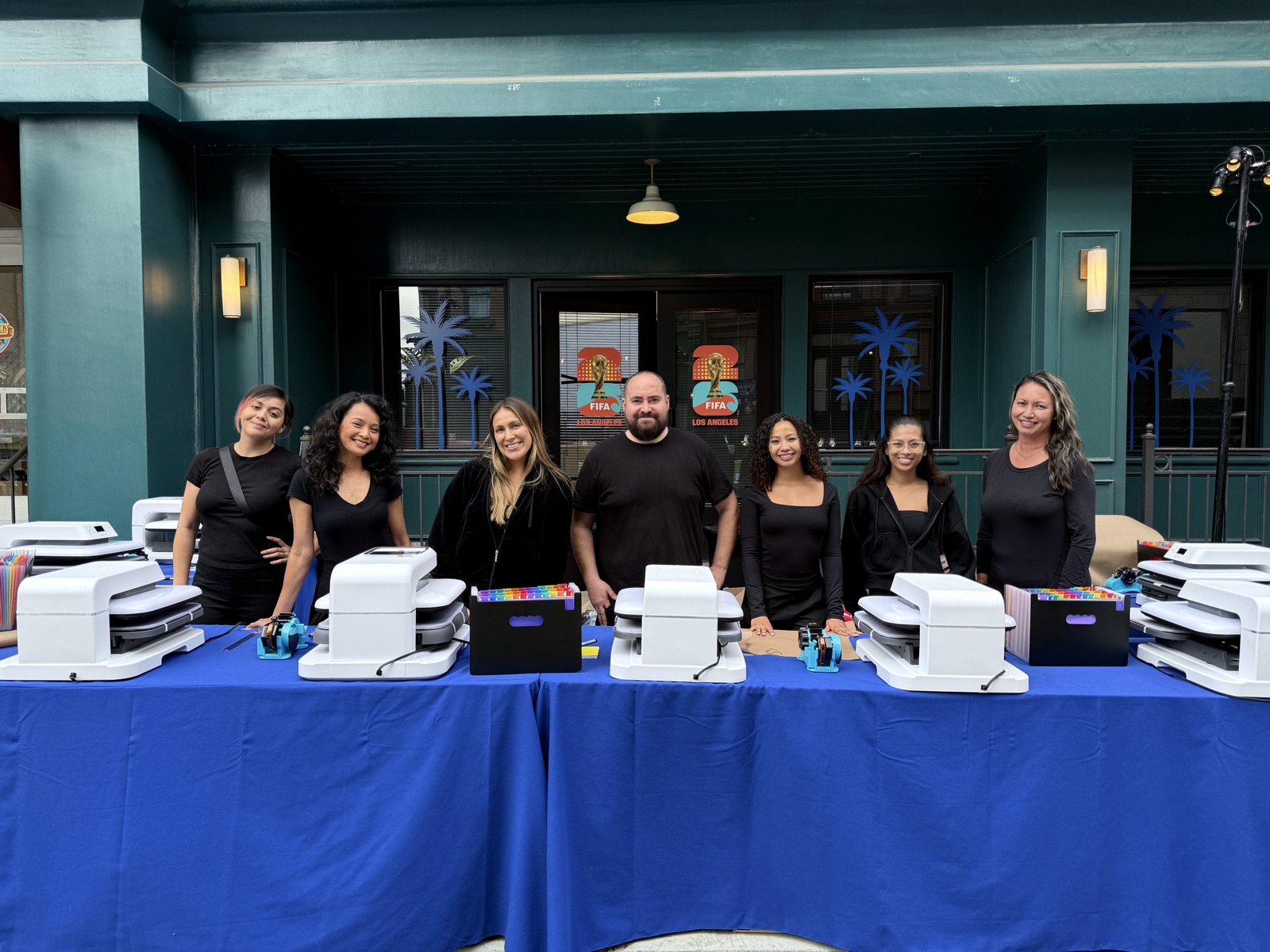
Here’s how most event merch dies: a team orders 1,000 pre-printed shirts to get the unit price down, hands out 700, and warehouses 300 — branded for an event that’s already over. The leftover boxes aren’t just waste; they’re the CMO’s least favorite line item. Print-on-demand live merch flips the model: bring blank inventory, print each piece only when a guest chooses it, and roll unprinted blanks forward to the next event.
Why bulk pre-printing overproduces by design
Bulk orders force three guesses months out: attendance, size curve, and design appeal. Every guess gets padded “to be safe,” and the padding compounds — that’s how 30% overage becomes normal. On-demand production removes the guessing: the size curve is whatever guests actually are, the design mix is whatever they actually pick, and production stops when the line does.
What zero-waste looks like operationally
- Blanks arrive undecorated — they carry no event branding, so leftovers stay usable inventory, not landfill.
- Every print is claimed before it exists: no print without a guest asking for it.
- Test prints get recycled, and the size buffer that would have been overage simply returns to stock.
- Post-event, the store stays open: an optional online store add-on keeps the designs available for latecomers without a second production run.
The sustainability-mandate angle
If your company reports on procurement sustainability, event swag is an easy win to claim: on-demand production converts a guaranteed-overage purchase into a zero-overage one. That single sentence — “merch was produced on demand with no overrun” — does more for an ESG slide than a recycled-polyester tag ever will. It also plays well publicly: guests watch the piece get made right in front of them, so the no-waste story tells itself.
Does on-demand cost more per shirt?
Per printed shirt, sometimes. Per useful shirt, almost never — bulk pricing looks cheap until you divide the invoice by the 700 shirts that actually reached humans. On-demand also buys things bulk can’t: personalization, live-event energy, and the booth-traffic effects covered in our trade show lead-capture playbook. For budget ranges, see pricing.