
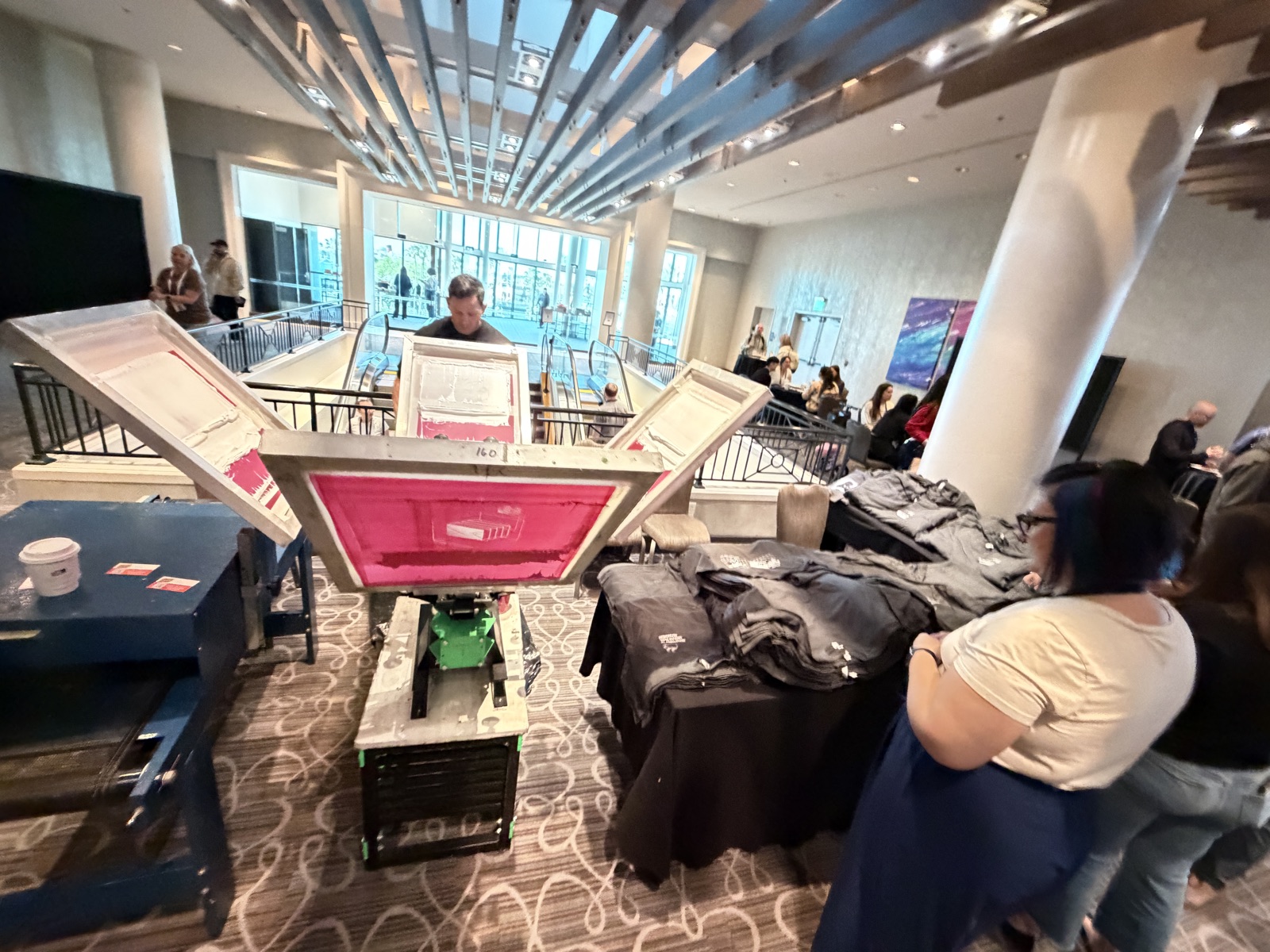
Choosing between screen printing vs DTF at events is the first real decision most brands face when planning a live merch activation. Both methods can decorate apparel on-site while guests watch, but they behave very differently under the pressure of a live crowd, a fixed footprint, and a line that needs to keep moving. Get the match right and your booth becomes the attraction; get it wrong and you either overpay for flexibility you don't need or bottleneck a queue you can't clear. This guide breaks down on-site screen printing and live DTF printing across the five variables that actually matter at an event — cost, speed, durability, color, and personalization — so you can pick the method (or combination) that fits your goals.
Why the method matters more at a live event
In a production shop, choosing a decoration method is mostly about price and finish. At a live event, it's also about spectacle and flow. The whole point of an activation is that people stop, watch, and share — and the numbers back up the investment. The experiential marketing market is projected to sit above $55 billion in 2026, with the large majority of B2B and consumer marketers planning to increase event spend, in part because a striking share of attendees create and share social content from the experiences they attend. Your print method shapes that moment: it determines how fast the line moves, how the finished merch looks in a phone photo, and whether guests can put their own name on it. Before comparing the two head to head, it helps to understand how each one works on the ground — our complete guide to live event printing covers the full setup end to end.
On-site screen printing: the high-volume workhorse
Screen printing pushes ink through a stenciled mesh screen onto the garment, curing into a durable, premium-feeling print. It is the oldest method at the table and still the standard for volume. Once a screen is burned for a design, each pull is fast and cheap, which is why screen printing dominates when you need hundreds of identical pieces of a bold, one- to three-color design.
At an event, on-site screen printing is pure theater: the press rotates, the squeegee pulls, the shirt comes off the platen, and a fresh one goes on. That rhythm is mesmerizing to a crowd and photographs beautifully. The trade-off is setup. Each color needs its own screen, and each design swap costs time, so screen printing rewards a tight, curated art menu over per-guest customization. It also asks for more space and power for the press and curing station. When your activation centers on one or two hero designs and high throughput, this is the method to beat — our on-site screen printing page details the press setup and staffing.
Live DTF printing: the full-color flex
Direct-to-film (DTF) printing takes the opposite approach. Artwork is printed onto a film transfer, coated with adhesive powder, and heat-pressed onto the blank. Because the image is digital, a single DTF station can run unlimited colors, photo-real gradients, and instant design swaps with zero screen changes. That flexibility is exactly what modern activations want.
For events, live DTF printing unlocks the things screen printing can't do easily: full-color logos, complex illustrations, and true personalization — names, numbers, dates, and one-off variations printed on demand. The footprint is compact and throughput is strong, though each personalized piece takes slightly longer than a fixed screen-printed pull because artwork is generated per guest. If your activation lives or dies on choice and customization, DTF is usually the answer. For a quick side-by-side, we also maintain a dedicated answer on live screen printing vs live DTF.
Head to head: the five variables that decide it
1. Cost
For a large run of a single design, screen printing almost always wins on price per piece: once the screens are burned there are no per-color digital costs, and the marginal cost of each additional shirt is low. For small or highly varied runs, DTF wins because there are no screens to burn and no setup fees to recover — the break-even between the two typically lands somewhere in the low dozens of pieces per design. The important nuance for events is that the print method is rarely the biggest line item. Staffing, station count, event length, travel, and blanks drive the budget far more than ink or film, which is why activations are quoted as packages. See our pricing page for how those variables come together.
2. Speed and throughput
A single staffed station handles roughly 40 to 120-plus guests per hour depending on method and design complexity. A fixed two-color screen print at high volume sits at the fast end of that range; full-color, personalized DTF sits a little lower because each transfer is unique. The right move for a high-traffic window isn't to rush one press — it's to size stations and crew to your peak. A queue that visibly moves is part of the show; a stalled line is a liability.
3. Durability
Both methods hold up well when applied correctly — a properly cured screen print and a quality DTF transfer will each clear 50-plus wash cycles. They fail differently, though: screen prints tend to crack as they age, while DTF gradually thins or fades without cracking. For event giveaways that guests wear casually, either finish will comfortably outlast the news cycle of your activation. Application quality matters more than the method label.
4. Color and detail
This is DTF's clearest edge. If your artwork is a photo-real image, a gradient, or a multi-color logo, DTF reproduces it cleanly with no color-count penalty. Screen printing can produce stunning results too, with a hand feel many people prefer, but every additional color adds a screen, setup, and cost — so it's happiest with bold, limited-color designs.
5. Personalization
If guests want their name, a jersey number, an event date, or a choice of variations, DTF is built for it. Screen printing simply can't swap artwork per guest without burning new screens, so it's the wrong tool for live customization. When personalization is the hook, DTF (or embroidery for a premium touch) is the method that keeps the experience individual.
So which should you choose?
Reach for on-site screen printing when you have one or two hero designs, a big crowd, and a goal of maximum throughput and a premium finish — think festivals, sponsor giveaways, and high-volume brand moments. Reach for live DTF printing when full color, complex artwork, or per-guest personalization is central — think product launches, conferences, and activations where choice drives engagement.
And here's the answer most planners land on: run both. Many of the strongest activations pair a screen-printing station for the flagship design with a DTF station for personalization, giving guests a fast lane and a custom lane at once. Because Merch Troop crews run screen print, DTF, embroidery, UV DTF, and laser under one roof, you don't have to force one method to do a job it's bad at. Our case studies show how this multi-method approach played out for brands like Riot Games, Coca-Cola, and Sony. Tell us your event date, guest count, and artwork, and we'll recommend the setup — and send a tailored quote within 24 hours.